Build secure collaborative browsing with the Zoom Cobrowse SDK
We recently launched the Zoom Cobrowse SDK, it provides you with all the tools to easily integrate a collaborative browsing experience into your customer engagement flow. The SDK also comes with a set of useful features like annotation tools and masking feature which can be configured to prevent end user's sensitive information from being seen by agents. In this blog, we'll showcase how to get started with the SDK.
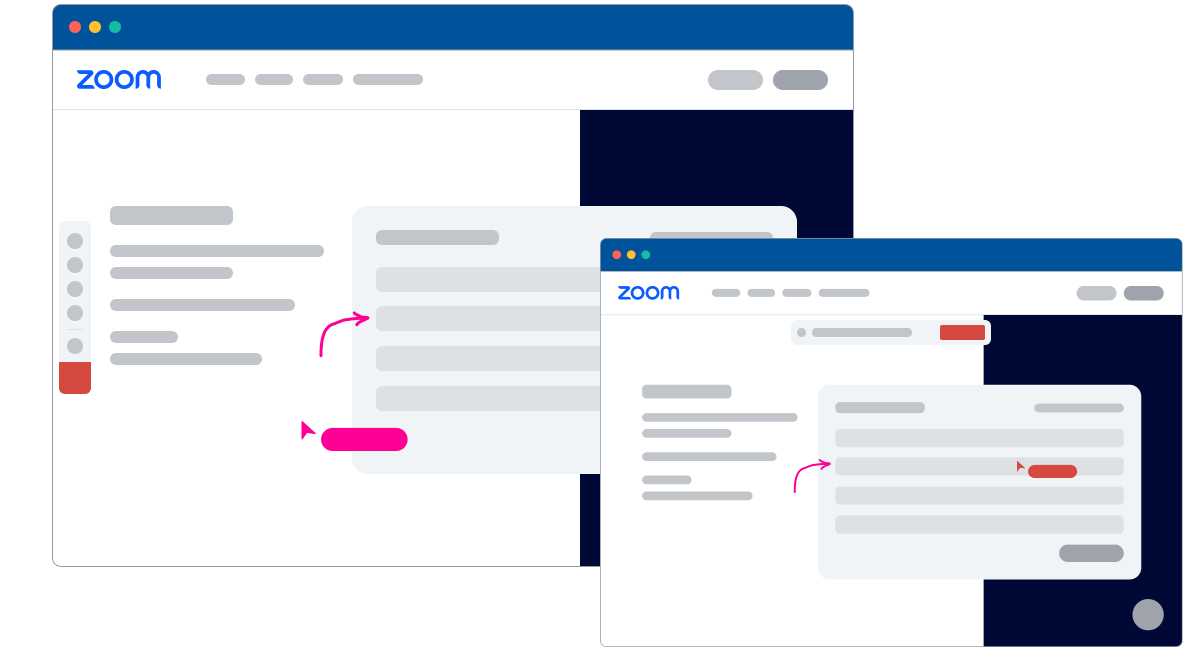
The Cobrowse SDK has two entry points, one for the customer and one for the agent:
Customer: Any user who is navigating your company website and can allow agents to view the same website with them at the same time during the cobrowse session.
Agent: Your company’s staff who support your end users in performing various tasks such as completing a purchase or helping users fill out out a form.
Prerequisites:
- Node LTS & NPM
- A Zoom SDK Universal Credit account
Step 1: Get SDK Credentials
Login to the Zoom Marketplace and make sure you have subscribed to the Zoom SDK Universal Credit plan. Obtain your SDK Key & Secret by clicking on the Develop button on the top right and selecting the Build SDK option. Make sure you grab the SDK credentials and not the API credentials.
You can find more information in our docs.
Step 2: Scaffold a Customer Form
We've create a sample app with two pages, one for the customer and one for the agent. We'll start by cloning the repo at the scaffold branch and installing the dependencies:
git clone https://github.com/zoom/CobrowseSDK-Quickstart --branch scaffold
cd cobrowsesdk-quickstart
npm install
It's a barebones Vite app with two pages, one for a customer form and one for the agent portal. We'll walk through adding the ability for the customer to cobrowse a simple form with a support agent. You can find the completed demo on the main branch.
Step 3: Deploy a Server for Token Generation
To authorize a cobrowse session, both the customer and the agent need to have a JSON Web Token (JWT). We've created a simple token generator that you can use for this demo. You can host it on a platform like Railway/Render by clicking the respective buttons in the repo, you'll be asked for your SDK Key and Secret.
You can also run it locally by cloning the repo, adding your SDK Key and Secret to .env file & running the following commands:
git clone https://github.com/zoom/cobrowsesdk-auth-endpoint-sample
cd cobrowsesdk-auth-endpoint-sample
npm install
npm run start
Copy the server URL and keep it handy. We'll use it in the next step.
Step 4: Fetch Tokens and Create Entry Points
Now that we have the server URL, we can generate a token for the customer and the agent. Navigate back to the cobrowsesdk-quickstart repo we cloned earlier and paste the server URL & SDK Key into the .env file.
VITE_ZOOM_SDK_KEY=YOUR_SDK_KEY_HERE # xxxx-yyyy_zzzz
VITE_TOKEN_URL=YOUR_TOKEN_URL_HERE # http://localhost:4000/
In our index.html, we have buttons for agent and customer. When either is clicked, we'll generate the token with that role and redirect the user to the respective page. Note: Customer has the role set to 1 and agent has the role set to 2.
We'll create a token.js file in the src folder. We can access the SDK Key and Server URL from the environment variables we set in the .env file.
const sdkKey = import.meta.env.VITE_ZOOM_SDK_KEY;
const serverUrl = import.meta.env.VITE_TOKEN_URL;
We'll define a function fetchToken that will make a POST request to the token URL with the SDK Key and the role of the user.
...
async function fetchToken(role) {
  const token = (
    await (
      await fetch(serverUrl, {
        method: "POST",
        headers: { "Content-Type": "application/json" },
        body: JSON.stringify({ role: role }),
      })
    )
      .json()
      .catch((e) => {
        console.error(e);
        alert("Please provide a valid token url");
      })
  ).token;
  return token;
}
Next, we'll add event listeners to the buttons that will call the fetchToken function with the correct role & open the respective pages adding the token as a query parameter.
...
const customerButton = document.getElementById("cb-btn");
const agentButton = document.getElementById("iframe-btn");
customerButton.addEventListener("click", async () => {
  const token = await fetchToken(1);
  window.open(`customer.html?token=${token}`, "_blank");
});
agentButton.addEventListener("click", async () => {
  const token = await fetchToken(2);
  window.open(`agent.html?token=${token}`, "_blank");
});
Finally, we can add this script to the index.html file with a script tag (before closing the body tag):
...
+ <script type="module" src="./src/token.js"></script>
</body>
Step 5: Add Cobrowse to the Customer Form
Zoom Cobrowse SDK can be added to a website by using the code snippet in our documentation. This snippet requires the SDK Key and will load the SDK. We'll create another script as src/customer.js and add it to the customer.html file. Make sure the SDK snippet is loaded before your script by adding it before your script tag. We'll add this before closing the head decleration:
...
  <script type="module">
+   const ZOOM_SDK_KEY = import.meta.env.VITE_ZOOM_SDK_KEY;
+   (function (r, a, b, f, c, d) { r[f] = r[f] || { init: function () { r.ZoomCobrowseSDKInitArgs = arguments } }; var fragment = a.createDocumentFragment(); function loadJs(url) { c = a.createElement(b); d = a.getElementsByTagName(b)[0]; c["async"] = false; c.src = url; fragment.appendChild(c) } loadJs(`https://zcb.zoom.us/static/resource/sdk/${ZOOM_SDK_KEY}/js`); d.parentNode.insertBefore(fragment, d) })(window, document, "script", "ZoomCobrowseSDK");
  </script>
+ <script type="module" src="/src/customer.js"></script>
</head>
We'll also add a button with the cb-btn and set it to disabled. The user can click this button to start a Cobrowse session.
...
<body>
  <div id="app>
+
...
In our script, we can obtain the token from the query parameter and define a variable sessionRef to hold the cobrowse session object after instantiation:
const token = new URLSearchParams(document.location.search).get("token");
const btn = document.getElementById("cb-btn");
let sessionRef = null;
Next, we'll define the settings for the cobrowse session. We'll allow annotation and set .hide-me CSS class as the selector to hide user input:
...
const settings = {
  allowAgentAnnotation: true,
  allowCustomerAnnotation: true,
  piiMask: {
    maskCssSelectors: ".hide-me",
    maskType: "custom_input",
  },
};
We can now call the init method on the ZoomCobrowseSDK instance passing in our settings object and a callback function, this initalizes the SDK. If this succeeds, we can access a session object and add event listeners to it inside the callback function. We can listen for events like pincode_updated, agent_joined, session_started etc. We'll store the session in the sessionRef variable to access out of this callback function and enable the button to start the session:
...
ZoomCobrowseSDK.init(settings, function ({ success, session, error }) {
  if (success) {
    session.on("pincode_updated", (payload) => {
      console.log("pincode_updated", payload);
    });
    sessionRef = session;
    btn.disabled = false;
    btn.innerText = "Cobrowse";
  } else {
    console.log(error);
  }
});
We'll define a startSession function that will start the cobrowse session by calling the start method on the sessionRef and passing in the token. We'll add a click event listener to the "cobrowse" button to call this function:
...
const startSession = () => {
  if (!sessionRef) {
    alert("Please wait...");
    return;
  }
  btn.disabled = true;
  sessionRef.start({ sdkToken: token });
};
btn.addEventListener("click", startSession);
Step 6: Setup the Agent Portal
The Zoom Cobrowse SDK support being embed on any page using an iframe.
We can add an iframe to the agent.html file. We'll access the token from the query parameter and set the src attribute of the iframe to the agent portal URL.
  <iframe width="1024" height="768" src="" id="iframe"
    allow="autoplay *; camera *; microphone *; display-capture *; geolocation *;">
  </iframe>
  <script>
    const token = new URLSearchParams(document.location.search).get('token');
    const iframe = document.getElementById('iframe');
    iframe.src = `https://zcb.zoom.us/sdkapi/zcb/frame-templates/desk?access_token=${token}`;
  </script>
</body>
That's all the code you need to add to the agent portal, you can easily embed this experience in your existing agent portal.
Step 7: Run the Project
You can run the project by executing:
npm run start
You can access the customer/agent page by clicking the respective buttons. Make sure your token server is running/deployed.
The customer can click the Cobrowse button, they'll see a session code inside a modal. They can share this code with an agent to being Cobrowse.
The agent can input the session code given by the customer on their portal and start Cobrowse.
Conclusion
With the Zoom Cobrowse SDK, you can easily add secure collaborative browsing to your website. This will allow your customers to cobrowse with your agents, enabling them to perform tasks such as completing a purchase or helping users fill out out a form. The SDK also comes with a set of useful features like annotation tools and masking feature that can be configured to prevent leaking sensitive user information. You can read more about the SDK in our docs.